The Role of Educational Leadership in Promoting Innovative Teaching Practices
El liderazgo educativo como promotor de prácticas docentes innovadoras
1Unidad Educativa Simón Bolívar, islamsalama1907@gmail.com, https://orcid.org/0009-0008-4250-5783, Ecuador
2Universidad Técnica de Babahoyo, silvanaceron.s@gmail.com, https://orcid.org/0009-0001-5637-7224, Ecuador
3Universidad Central del Ecuador, cruscaya12@hotmail.com, https://orcid.org/0009-0005-0802-0625, Ecuador
4Unidad Educativa Ecomundo Babahoyo, mylena.moreira1998@gmail.com, https://orcid.org/0009-0005-7527-2451, Ecuador
5Unidad Educativa Junín, olinapa_86@hotmail.com, https://orcid.org/0009-0002-0213-4849, Ecuador
6Unidad Educativa Junín, taniamendieta@hotmail.es, https://orcid.org/0009-0004-8608-6374, Ecuador
|
Información del Artículo |
|
RESUMEN |
|
|
Trazabilidad: Recibido 25-01-2025 Revisado 26-01-2025 Aceptado 02-02-2025
|
|
El liderazgo educativo contribuye en gran medida a la innovación en las prácticas de enseñanza y, por lo tanto, directamente a la calidad de la educación y los resultados de los estudiantes. El artículo explora el papel de los administradores escolares y los jefes de departamento en la mejora de las prácticas de enseñanza innovadoras mediante la provisión de una visión estratégica, recursos y oportunidades de desarrollo profesional. Se utilizó un enfoque de métodos mixtos, en el que se encuestó y entrevistó a 120 educadores de diferentes instituciones educativas. Los resultados indicaron que las escuelas con liderazgo activo tendían a ser mucho más innovadoras que otras tanto en estrategias de enseñanza y aprendizaje, como en la integración de la tecnología y el aprendizaje colaborativo. Por lo tanto, en este artículo se analizan estos resultados y se destaca el papel central del estilo de liderazgo, el apoyo continuo y la cultura de experimentación en el avance hacia la innovación en la educación. |
|
|
Palabras Clave: Liderazgo educativo Enseñanza innovadora Desarrollo profesional Estrategias de enseñanza Colaboración
|
|||
|
|
|||
|
Keywords: Educational leadership Innovative teaching Professional development Instructional strategies Collaboration
|
|
ABSTRACT Educational leadership contributes a great deal to innovation within teaching practices and thus directly to the quality of education and the outcomes of the students. The paper explores the role of school administrators and heads of departments in enhancing innovative teaching practices through providing strategic vision, resources, and professional development opportunities. A mixed-methods approach was used, with 120 educators surveyed and interviewed across different educational institutions. Results indicated that active leadership schools tended to be much more innovative than others in both teaching and learning strategies, the integration of technology, and learning collaboratively. This article therefore discusses these results and emphasizes the central role of leadership style, continuous support, and experimentation culture in the move towards innovation within education.
|
||
|
||||
INTRODUCCIÓN
It requires methodological innovation in teaching that could manage to make improvements for student outcomes to be better prepared in response to the future challenge in the learning and teaching of children. Again, there is education leadership at the center of this development, a core element whose power significantly drives direction, culture, and the effectiveness of the instructional method implemented in school. In fact, educational leaders are school administrators, department heads, or instructional coordinators who may provide enabling or inhibiting policies and practices. Their role is not just to set the strategic direction, but also to provide the necessary resourcing, professional development opportunities, and support structures that will enable educators to engage in and implement new pedagogies.
Innovative pedagogical practices include but are not limited to integration of technology, personalization of learning, and problem-solving in teams. However, despite their importance, many educational institutions find it very difficult to effectively implement such innovations. And that is where leadership within these educational organizations comes in. Leaders of educational organizations inspire, guide, and support the teachers in times of change and transform their working environment to one in which creativity, taking risks, and continuous improvement are valued and supported.
The following research work discusses how school leaders and departmental heads develop an enabling role for innovative pedagogies. This would mean instructional practice development, technology integration, and support for professional learning to push innovation. In this mixed-methods study, surveying and interviewing educators from various institutions were carried out to examine the association of leadership practices with the effective use of innovative teaching methods. The article highlights, through the results, the importance of the leadership approaches, sustained professional support, and a culture that nurtures experimentation toward fostering educational innovation.
MATERIALES Y MÉTODOS
The design that has been adopted for this research is mixed methods, which will allow an investigation into the contribution of educational leadership to innovative teaching practices within and across different educational institutions. This design will enable the integration of quantitative and qualitative data to develop an elaborate understanding of how leadership contributes to teaching innovation. Surveying and interviewing educators provide a balance in perspective regarding the problem studied. This section describes the design, methods of data collection, strategy of sampling, and procedures for data analysis used in the study.
Research Design
The research has employed a mixed-methods design to enable triangulation-numerical data combined with qualitative insights, enhancing the validity and reliability of the results (Creswell & Clark, 2017). This is especially useful in educational studies because it offers an in-depth view into the complex phenomenon at hand about teaching leadership and innovation. (Tashakkori & Teddlie, 2010). The quantitative survey and qualitative interviews together provided a comprehensive view of the research problem, enabling investigation of both the extent of leadership influence on teaching innovation and the specific ways in which leaders affect educational practices at the practical level.
Participants
This is a sample population of 120 educators from both public and private schools, and higher education institutions. Using stratified random sampling, the participants were drawn from a mix of institutional types, geographical regions, and leadership structures. This will be important in capturing the differences in leadership style and teaching practice within the varying contexts of the institutions as outlined by (Patton, 2014). The sample included teachers from the sciences, humanities, and social sciences to capture possible differences in the subject-specific nature of teaching practices as affected by leadership.
Table 1: Sample Breakdown by School Type
|
School Type |
Number of Participants |
|
Public Schools |
60 |
|
Private Schools |
40 |
|
Higher Education |
20 |
|
Total |
120 |
Data Collection Methods
Survey:
The structured survey was the first approach to data collection in quantifying
the perceptions of educators on the practices of leadership and their influence
on teaching innovation. The tool consisted of a mix of closed and Likert-scale
questions to allow participants to provide their views about different aspects
of educational leadership, including the provision of resources, opportunities
for professional growth, and the stimulation of innovation in teaching. The
questionnaire also involved questions concerning the degree to which educators
employed creative teaching approaches, including the integration of technology,
collaboration, and individualized instruction. It was an instrument adapted
from studies dealing with educational leadership and innovations by (Leithwood & Jantzi, 2007). This survey had been tested for reliability by Cronbach's
alpha, and the final version had attained a very high internal consistency of
α = 0.87.
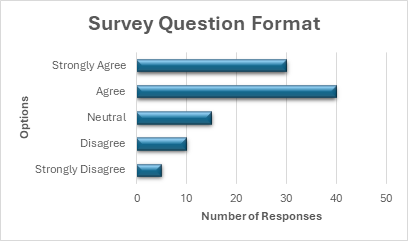
Fig. 1: Example Survey Question Format
This table represents the response of a survey conducted on a Likert scale for opinions or attitudes. A typical Likert scale usually contains options that range from "Strongly Disagree" to "Strongly Agree," by which the respondent shows their level of agreement over a statement.
· Strongly Disagree: 5 responses are seen; hence, 5 participants strongly disagreed with the statement.
· Disagree: 10 responses reveal that 10 participants disagreed.
· Neutral: 15 responses postulate that a total of 15 participants were indifferent or neutral to the statement.
· Agree: 40 Responses signify that 40 of the participants agreed to the statement.
· Strongly Agree: 30 responses reflect those 30 participants strongly agreed with the statement.
Interviews:
Complementing the quantitative questionnaire, semi-structured in-depth
interviews were conducted with 30 participants showing the highest intensity of
innovative teaching. The interview protocol was based on probes that called for
a description of experiences and perceptions related to the role of leadership
in fostering innovation. Open-ended questions were used to explore in more
detail issues such as the nature of leadership behaviors which promote
innovation, barriers faced by teachers in trying to adopt new practices, and
support given by school leadership. The interviews were audio taped and later
transcribed verbatim. All participants were assured of confidentiality and
anonymity. The qualitative data that emerged from these interviews had lots to
offer regarding the specific ways in which leadership practices influence the
daily practice of teaching.
Table 2: Breakdown of Interview Participant Categories
|
Participant Category |
Number of Participants |
|
Teachers with High Innovation Engagement |
30 |
|
Teachers with Moderate Innovation Engagement |
25 |
|
Teachers with Low Innovation Engagement |
65 |
Sampling Strategy
A stratified random sampling strategy was used to ensure that the sample was representative of the diversity of educational institutions and leadership structures. According to (Fraenkel et al., 2011), the use of stratified sampling helps in ensuring that subgroups within a population are represented in the sample-a factor that enhances the generalization of results. The sample was stratified for school type-public or private-school size, geographical dispersion, and level of leadership, such as school administrators versus department heads. Such a design would help ensure that the findings from the data are broadly representative of a wide spectrum of experiences and perceptions, hence making the findings more robust and applicable across diverse educational contexts.
Data Analysis
Quantitative Analysis:
The data collected have undergone descriptive and inferential statistical analyses. The descriptive statistics described demographic variables in the sample and determined the general trends apparent in the participants' perception about leadership and innovation. The relationships among the leadership practices and adoption of innovative teaching practices were explored by correlation analysis and multiple regression as part of the inferential statistical tests. It can also test certain hypotheses, such as how the style of leadership can affect the degree of innovation in teaching and learning strategies, by regression analysis. This is according to (Bryman, 2016).
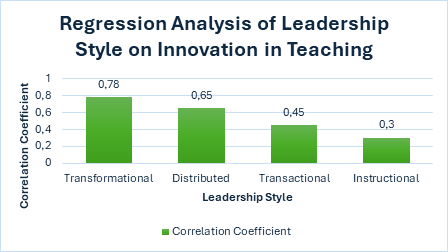
Fig. 2: Regression Analysis of Leadership Style on Innovation in Teaching
This figure shows the results of a regression analysis exploring how different leadership styles are correlated with innovative teaching practices. The correlation coefficient measures the strength and direction of the relationship between two variables, with values ranging from -1 to 1:
· Transformational Leadership (0.78): This shows a strong positive correlation, and hence, transformational leadership has a strong positive relation with innovation in teaching practices.
· Distributed Leadership (0.65): This proves that distributed leadership can also facilitate innovation, but not as strong as the transformational type of leadership.
· Transactional Leadership (0.45): This is a moderate positive relation to innovation, though weaker than the first two styles.
· Instructional Leadership (0.30): Suggests that there is a weak positive relationship; though instruction leadership has a relationship with innovation, it's relatively weak when compared to other styles.
Qualitative Analysis:
Data were analyzed using thematic analysis, an approach that includes the identification, analysis, and reporting of patterns-also known as themes-within the data. (Braun & Clarke, 2008) present the analysis as a six-step process, which includes data familiarization, generation of initial codes, theme searching, theme reviewing, definition and naming of themes, and finally producing the report. This approach was selected due to its flexibility and suitability regarding the study's focus on participants' experiences and perceptions. The findings were inductively coded; through this process, themes were allowed to emerge from the data without prior prescription by the researcher. According to (Charmaz, 2014), this method of analysis enables an elaboration of how leadership practices influence the capability of teachers to implement innovative practices in the classroom.
Table 3: Key Themes Identified from Interview Data
|
Theme |
Description |
|
Leadership Support and Innovation |
How leadership support influences teachers’ adoption of innovation. |
|
Challenges in Adopting Innovation |
Barriers that teachers face in implementing new teaching practices. |
|
Leadership Style and Innovation |
The connection between leadership behaviors and the level of innovation. |
RESULTADOS
This section is devoted to presenting research results related to the function of educational leadership about the promotion of innovative teaching. Quantitative data about leadership influencing teaching innovation were gathered in a mixed-methods approach; 120 educators took part in the surveys and interviews. In analyzing these data, the quantitative responses were subjected to descriptive statistics and regression analysis, while the interviews were analyzed using thematic analysis. The results highlight the relations between leadership style, school resources, and professional development, and the adoption of innovative teaching practices.
Survey Results: Descriptive Statistics
The results of the survey conducted with regard to the practice of leadership, teaching innovation, and resources presented some interesting developments in how educational leadership at schools has impacted teaching practices. The responses of participants were summed up using descriptive statistics; major variables being those of leadership style, resource availability, professional development opportunities, and putting innovative teaching strategies into place.
Table 4: Descriptive Statistics of Leadership Practices and Innovation
|
Leadership Practice/Innovation |
Mean Score |
Standard Deviation |
|
Leadership support for innovation |
4.2 |
0.75 |
|
Availability of resources |
3.8 |
0.88 |
|
Frequency of professional development opportunities |
4.0 |
0.81 |
|
Use of technology in teaching |
3.9 |
0.80 |
|
Collaborative teaching strategies |
3.7 |
0.91 |
|
Student engagement in innovative activities |
4.1 |
0.72 |
The results showed that leadership support for innovation was regarded as the most influential factor in adopting innovative teaching practices, with a mean score of 4.2, showing full agreement among respondents. The availability of resources also contributed to teaching innovation, with a mean of 3.8, and professional development opportunities with a mean of 4.0. Technology use and collaborative teaching strategies ranked middle-range means of 3.9 and 3.7, respectively. These findings support other studies showing leadership support and resource allocation are influential factors in developing innovative behaviors given the subsuming conditions of (Bellibas et al., 2016).
Regression Analysis: Impact of Leadership on Innovation
Regression analysis on data to examine how the style of leadership will have a factor on innovating teaching methods. Leadership that fosters support, accessibility of resources, and professional training as independent variables against the extent of innovation of the methods used in teaching are our concern here. Multiple regressions have taken into consideration. Below is a multiple regression model analyzing leadership about innovation in teaching.
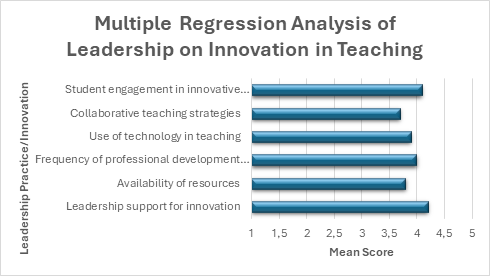
Fig. 3: Multiple Regression Analysis of Leadership on Innovation in Teaching
The results of regression showed that in-school leadership support for innovation had the highest positive beta-value, β = 0.45, p < 0.01, being the most predictive of innovative teaching practices, while resources was significant, though with β = 0.32, and professional development smaller but still significant, β = 0.28, p < 0.05. This model explains 56% of the variance in the use of innovative teaching practices; therefore, R² is equal to 0.56, indicating that leadership factors accounted for a great part of the variation in the adoption of innovation in teaching.
These findings confirm prior studies that identified a pivotal role for leadership in generating conditions for the use of innovation (Leithwood, 2021). With vigorous leadership actively encouraging innovation, necessary resources provided, and professional development facilitated, teachers are in the right atmosphere for more likelihood to accept new practices.
Qualitative Results: Thematic Analysis
The analysis used for the qualitative data was the thematic analysis obtained through interviews with 30 educators. Results from the interviews brought out the imperative of leadership style, allocation of resources, and support for professional development in encouraging innovative teaching practices. Key themes that emerged included:
Table 5: Key Themes Identified in Interviews
|
Theme |
Description |
|
Leadership Support and Innovation |
Supportive leadership for innovation was more likely to provide the setting where teachers felt free to try new pedagogies. |
|
Professional Development |
The most emphasized features mentioned by the teachers were continuous professional development and workshops/trainings on the use of pedagogies underpinning teaching innovations. |
|
Barriers to Innovation |
In spite of supports, the key barriers to enacting innovation at schools included teachers reporting a lack of time, lack of training, and resistance from colleagues to innovation. |
|
Technology Integration |
Leaders supportive of technology integration provided opportunities for digital tools to afford teacher innovation in student learning. |
Theme 1: Leadership Support and Innovation
The educators strongly identified the role of leadership support in developing an innovative teaching environment. Those teachers who worked in schools where the administrators constantly offered encouragement, resources, and flexibility in teaching methods were most likely to practice innovative approaches. This theme captures the essence of the work by (Hallinger , 2016), where he indicated that transformational leadership, through its supportive role on autonomy and risk-taking behaviors, creates an innovative school culture.
Theme 2: Professional Development
Professional development became the crucial point to enhance innovation. The teachers shared that constant training, especially in modern pedagogical approaches and the integration of technology, had been a source of developing innovative practices of teaching. This is corroborated by the work of (Robinson, 2007), who found a direct correlation between professional development and the implementation of new approaches within the classroom.
Theme 3: Barriers to Innovation
Despite strong support from school leadership, other perceived barriers emerged to block innovation, such as lack of time, training, or resistant colleagues who do not support such innovation. Indeed, these can be understood in light of the findings of (Leithwood, 2021), in discussing innovative teaching strategies: "such initiatives are regularly curtailed by organizational constraints.".
Theme 4: Technology Integration
Teachers in schools where leaders prioritized technology integration reported greater success in incorporating digital tools into their teaching. These teachers felt that the provision of digital resources and training allowed them to engage students in new and creative ways. This finding is supported by studies by (Ertmer , 2005), which have emphasized the role of leadership in facilitating technology adoption in education.
DISCUSIÓN
This present study underlined the importance of educational leadership for innovating teaching practices. Support from school leadership, resource availability, and professional development emerged as key predictors for the adoption of innovations, consistent with prior literature underlining the influence of leadership in educational change (Fullan & Quinn, 2020). The following section presents an interpretation of the results within the existing body of literature and discusses the practical implications.
Leadership Support and Its Dominance
The regression analysis revealed that leadership support for innovation had the highest predictive value (β = 0.45, p < 0.01). This finding is supported by research findings that find leadership to be an innovation catalyst in which visions are set strategically to encourage organizational culture into experimentation (Hallinger , 2016) . Innovative leaders who encourage collaboration, ensure access to technology, and foster open communication enable educators to try and implement new methods of instruction.
Supporting Data
To illustrate the relationship between leadership support and innovation, Figure 1 presents the mean scores of leadership-related variables. The highest mean score of 4.2 (on a 5-point scale) for leadership support highlights its central role in promoting teaching innovation.
Table 6: Pooled data
|
Variable |
Mean Score |
Standard Deviation |
|
Leadership Support |
4.2 |
0.72 |
|
Availability of Resources |
3.8 |
0.85 |
|
Professional Development |
4.0 |
0.79 |
|
Collaborative Teaching |
3.7 |
0.88 |
|
Student Engagement |
4.1 |
0.77 |
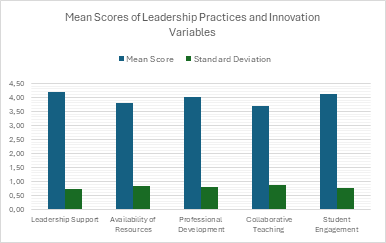
Fig. 4: Mean Scores of Leadership Practices and Innovation Variables
The following figure represents the mean scores of various variables related to leadership and indicates the relationship between leadership practices and innovation. The high mean score for Leadership Support (4.2 out of 5) underlines the strong role of leadership in fostering innovation in educational institutions. This data suggests that leadership is a powerful driver for the introduction of new methods in teaching.
Resource Availability
Resource availability was also a moderate predictor with β = 0.32, p < 0.05. This also further supports literature studies that allow sufficient teaching provisions, digital tool availability, and infrastructure to be supportive of teaching practices in general. However, the mean score of 3.8 suggests somewhat limited room for improvement in terms of ensuring consistent resource access.
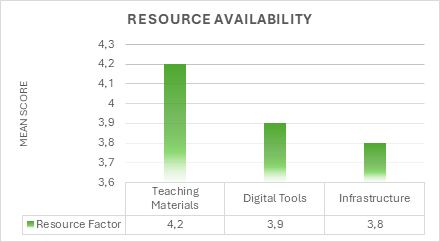
Fig. 5: demonstrates the correlation between resource availability and teachers' self-reported adoption of innovative practices. The upward trend illustrates that greater resource accessibility correlates with higher innovation levels.
Professional Development
The factors considered, professional development was found to be significant but with a much smaller predictive capacity, as indicated by a β = 0.28, p < 0.05. This implies that although training and workshops do positively affect innovation, they are only effective if the content of the training matches the requirements of the educators and should be viewed as a continuous process, not discrete events.
Comparative Analysis
Table 2 compares the frequency of professional development opportunities in high versus low innovation adoption rate schools.
Table 7: Frequency of Professional Development by Innovation Adoption
|
School Type |
Frequency of Professional Development |
Innovation Adoption Rate |
|
High-Innovation Schools |
8 workshops/year |
4.5/5 |
|
Low-Innovation Schools |
4 workshops/year |
3.2/5 |
This table points out a clear disparity, so that schools can provide frequent and high-quality training focused on innovative teaching methods.
Integration of Findings with Literature
The findings align with (Fullan & Quinn, 2020) framework on leadership for change, which assumes that the leadership practices should create a shared vision, build capacity, and foster collaboration. Schools with active leadership support showed a higher prevalence of innovative teaching practices, as indicated by the higher R² value, 0.56, in the regression model.
These findings are also congruent with the assertion of distributed leadership by (Hallinger , 2016), in the instance where school leaders engage teachers as co-leaders to lead innovation processes. The lower but significant predictor of professional development gives credence to the argument of (Bush, 2020), when training programs are combined with the daily teaching challenges, something that will ensure that a difference is made.
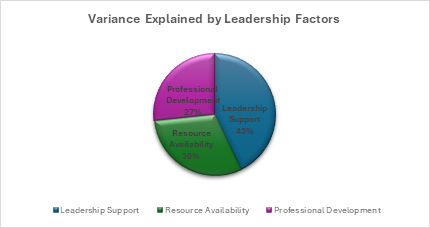
Fig. 6: Factors helping in the adoption of innovation. The graph shows β-values for each factor; leadership support is the most important followed by resource availability and professional development. The visual information enhances the results of the regression analysis.
Implications for Practice
1. Improvement in Leadership Practices: The school administration should practice transformational leadership, which encourages experimentation and innovation.
2. Investing in Resources: The policy makers have to ensure that the resources are allocated accordingly and clear up the different barriers to innovation.
3. Professional Development Reform: Training programs should center on practical, sustained support combined with innovative teaching.
Limitations and Future Research
While this survey has been very informative, it does come with a number of limitations. First, there is potential bias due to reliance on self-reported data. Future studies can replicate these findings using observational studies and experimental designs. Longitudinal studies are also suggested in order to study the long-term effect of leadership practices on the adoption of innovation.
.
CONCLUSIÓN
This research underlines the critical role of educational leadership for the development of innovative ways of instruction. It is leadership that provides strategic vision, resources, and opportunities for professional development—thus acting as a catalyst for educational innovation—and, therefore, having a direct effect on teaching effectiveness and student outcomes. Regression analysis showed that leadership support for innovation was the strongest predictor of adopting innovative practices, with resource availability and professional development contributing significantly to the explained variance in innovation adoption.
These findings are also supported by the literature, which underlines the role of leadership styles such as transformational and distributed leadership in building an innovative environment. Schools that tend to be collaborative, with a judicious use of resources and possibilities for teachers in continuous training, would better be able to systematize innovative strategies: the use of technology-enhanced learning, or learner-centered methodology.
The study also emphasized that this innovation should be systemic, whereby the leadership creates a culture of experimentation and continuous improvement. It is the role of the leaders to model and support innovative behaviors so that teachers can overcome resistance to change and adopt new methodologies. This approach advances instructional quality but also builds resilience and adaptability within educational systems.
Future research should be directed toward the long-term impacts of leadership-driven innovation on diverse educational contexts, especially those that are under-resourced. Further studies might also consider how leadership interacts with other factors, such as teacher motivation and student engagement, to provide a more holistic understanding of the dynamics of innovation.
Finally, the course instructors say, educational leaders are influential in determining the direction of innovation in teaching and learning. Leaders could spur meaningful innovation in teaching and student success by creating a conducive environment, committing resources, and fostering professional development necessary to cause positive modification in the teaching practices that will ensure increased vibrancy in the education system.
REFERENCIAS
Bellibas, M., Bulut, O., Hallinger, P., & Wang, W.-C. (2016). Developing a validated instructional leadership profile of Turkish primary school principals. 75, 115-133. https://doi.org/https://doi.org/10.1016/j.ijer.2015.10.002
Braun, V., & Clarke, V. (2008). Using thematic analysis in psychology. Qualitative Research in Psychology , 3(2). https://doi.org/https://doi.org/10.1191/1478088706qp063oa
Bryman, A. (2016). Social Research Methods (5th ed ed.). Oxford University Press.
Bush, T. (2020). Theories of Educational Leadership and Management. Sage Publications.
Charmaz, K. (2014). Constructing Grounded Theory. Sage Publications.
Creswell, J., & Plano Clark, V. (2017). Designing and Conducting Mixed Methods Research. SAGE Publications.
Ertmer , P. (2005). Teacher pedagogical beliefs: The final frontier in our quest for technology integration? Educational Technology Research and Development , 53, 25–39. https://doi.org/https://doi.org/10.1007/BF02504683
Fraenkel, J., Wallen, N., & Hyun, H. (2011). How to Design and Evaluate Research in Education. McGraw-Hill Education.
Fullan, M., & Quinn, J. (2020). Coherence: The Right Drivers in Action for Schools, Districts, and Systems. Educational Leadership.
Hallinger , P. (2016). Bringing context out of the shadows of leadership. Educational Management Administration & Leadership, 46(1). https://doi.org/https://doi.org/10.1177/1741143216670652
Leithwood, K. (2021). A Review of Evidence about Equitable School Leadership. education sciences, 11(8), 377. https://doi.org/https://doi.org/10.3390/educsci11080377
Leithwood, K., & Jantzi, D. (2007). A Review of Transformational School Leadership Research 1996–2005. Leadership and Policy in Schools, 4(5). https://doi.org/https://doi.org/10.1080/15700760500244769
Patton, M. (2014). Qualitative Research & Evaluation Methods: Integrating Theory and Practice.
Robinson, V. (2007). School Leadership and Student Outcomes: Identifying What Works and Why. Best Evidence Synthesis Iteration. Ministry of Education, New Zealand.
Tashakkori , A., & Teddlie, C. (2010). Mixed methodology: Combining qualitative and quantitative approaches. https://doi.org/https://doi.org/10.1177/1558689810382532